
As part of the European Green Week, the Europe House in Niš organized a lecture and discussion with expert Anđelka Sergienko, focusing on understanding greenhouse gas emissions and exploring ways to measure and reduce them in line with modern European standards and climate policies.
“A carbon footprint is essentially the sum of all emissions resulting from human activity — in other words, everything people release into the atmosphere. It is not limited to carbon dioxide, but includes all greenhouse gases, which are converted into carbon dioxide equivalents and expressed in tonnes of CO₂ equivalent,” Sergienko explained at the outset.
She went on to note that the greenhouse effect is a naturally occurring phenomenon in the Earth’s atmosphere and is essential for life as we know it. Without naturally present greenhouse gases, the Earth’s average temperature would be around –18°C instead of the current +15°C. The real issue, she emphasized, lies in the impact of human activity on the concentration of these gases in the atmosphere.
Understanding climate change has been a journey spanning more than 200 years — from Joseph Fourier’s 1824 discovery that the atmosphere retains heat, to the Paris Agreement in 2015 and the EU Climate Law adopted in 2021. This legislation sets clear targets: a 55% reduction in net emissions by 2030 and climate neutrality by 2050.
Serbia is a signatory to the Paris Agreement and has committed to reducing its emissions by 40% by 2030. For companies trading with the European Union, however, the Carbon Border Adjustment Mechanism (CBAM), which entered into force in 2023, is particularly significant. Simply put, if a company exports to the EU from a country that does not impose a carbon price, it will have to pay the difference at the border.
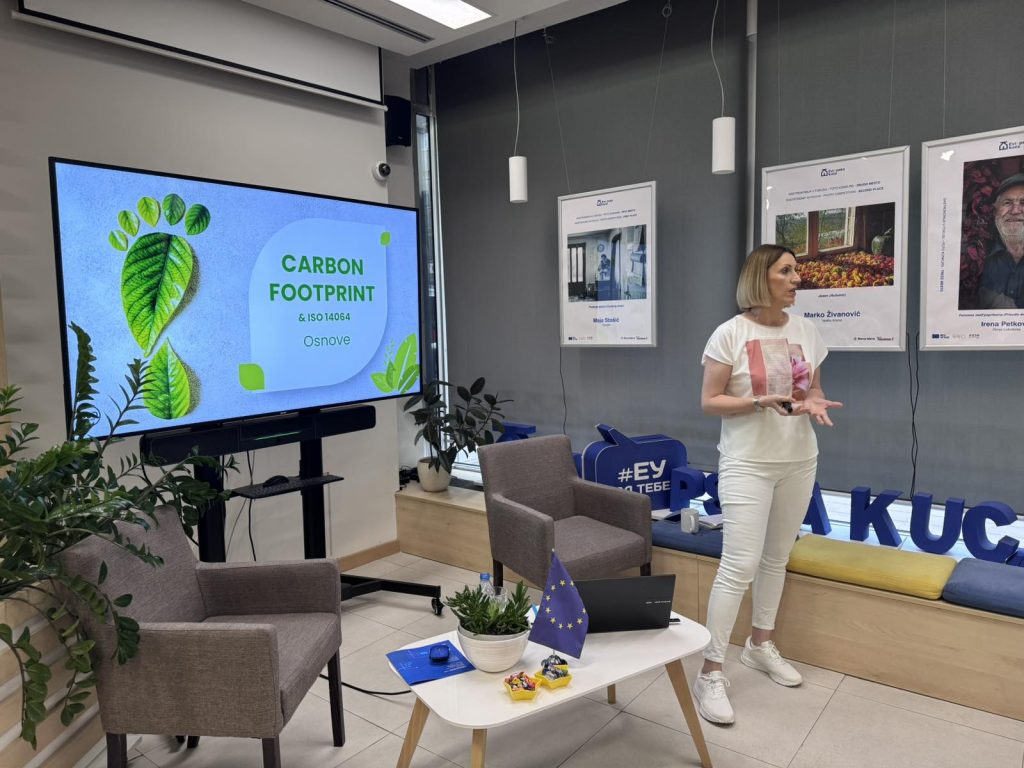
The central part of the lecture was dedicated to the ISO 14064 standard, which defines how organizations should measure and document their greenhouse gas emissions. Sergienko outlined the three components of the standard: the first relates to organizations and their emissions inventories, the second to emission-reduction projects, and the third to the verification of reports by accredited independent bodies.
“ISO standards are extremely important because they provide a set of rules whose implementation leads to measurable results. By applying the requirements of ISO 14064, organizations can accurately calculate their greenhouse gas emissions. Once those emissions are properly measured, specific projects can be implemented to reduce them,” Sergienko explained.
She concluded that this is not merely a matter of bureaucracy or taxation. Rather, it is about responding to the demands of nature itself, fulfilling our responsibility to society and humanity, and ultimately meeting the expectations of customers and consumers.
The strong interest shown by business representatives and experts in the field confirmed the relevance of this year’s Green Week theme, “Together Towards a Nature-Aligned Economy.”
For 25 years, Green Week has been the European Union’s leading environmental campaign and an annual opportunity to raise awareness, promote dialogue, and discuss current and future EU environmental policies. EU Green Week 2026 invites citizens to become part of the change through small everyday decisions that, collectively, can have a significant impact on the future of both nature and society.
The project “EU for the Green Agenda in Serbia” is implemented by UNDP, with technical and financial support from the European Union and in partnership with Serbia’s Ministry of Environmental Protection. The project is carried out in cooperation with the Embassy of Sweden and the European Investment Bank (EIB), with additional funding provided by the governments of Sweden, Switzerland, and Serbia.