

The so-called “Svoj na svome” law, on the basis of which the registration of citizens for the legalization of illegal buildings has ended, does not solve the problem of Roma settlements in Serbia, where about 120,000 people live.
The construction of buildings on land owned by the state and public companies is the biggest problem faced by residents of Roma settlements when trying to legalize their houses.
This is the main finding of the monitoring of the legalization of houses in Roma settlements in Serbia for the period 2015-2025. which was conducted by the YUROM Center from Niš and which was presented at the media conference in the European House in Niš.
Based on the results of the monitoring, a proposal for systemic solutions was prepared through the Preliminary Draft of the Law on the Legalization of Sustainable Informal Roma Settlements.
Osman Balić from the YUROM Center points out that “The Law on special conditions for recording and registering rights to immovable property Svoj na Svoj is a temporary administrative solution, but it does not solve the essential problem of settlements that have existed for decades and in the development of which the state itself participated through infrastructure support”.
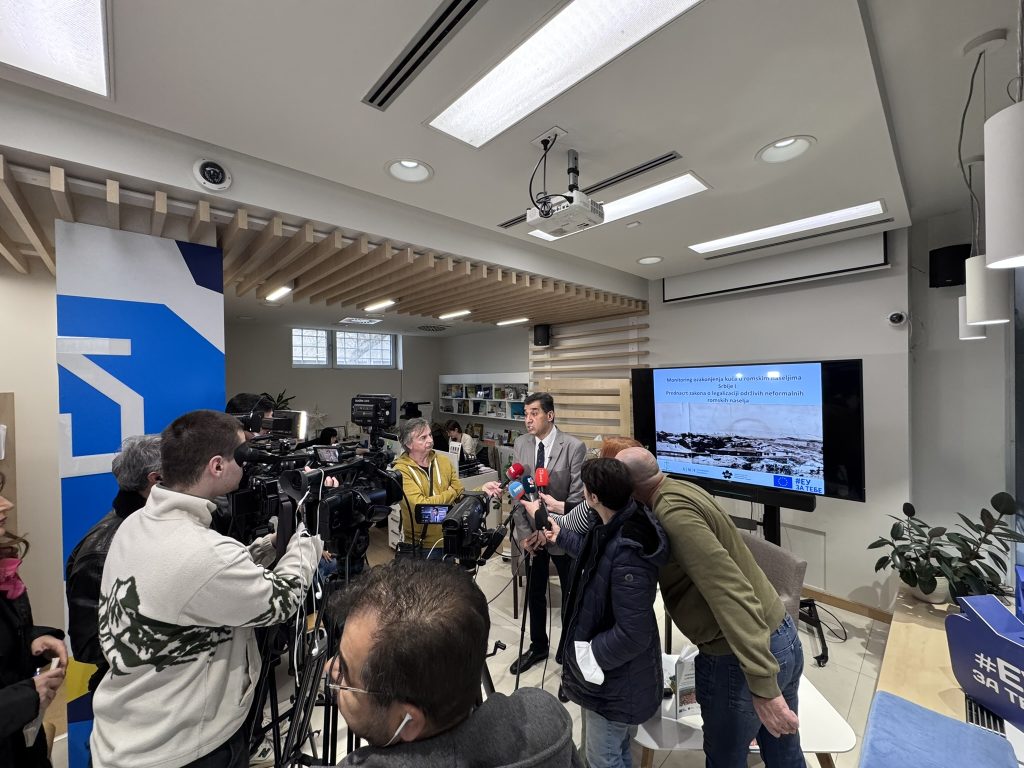
Monitoring has shown that the legalization of Roma settlements requires a special law that would enable a systematic solution to the land issue as a basic prerequisite for the legalization of buildings and the improvement of the living conditions of the approximately 120,000 people who live in these settlements.
“It is very important for us to create legal certainty, but the essence of the law is to solve the problem of the land, on which those Roma settlements are located, by means of affirmative action. Therefore, we need solidarity, and respect for the Constitution, and all the ties that stand when it comes to human rights, and above all, the right to an apartment, as the ultimate human right,” emphasizes Balić.
Concrete steps towards solutions are foreseen in the Preliminary Draft of the Law on Legalization of Sustainable Roma Settlements, which introduces a phased and planned approach to legalization:
- conducting an analysis of the condition of each Roma settlement with the participation of urban planners and community representatives;
- making a decision of the local self-government on the legalization and improvement of settlements;
- settlement of land-ownership relations through assignment or long-term use of state land to residents without compensation ;
- creation of settlement development action plans ;
- adoption of special urban plans that enable subdivision and infrastructural arrangement;
- demarcation of private and public land as a prerequisite for individual legalization of buildings;
- passing a decision on the legality of individual houses after settling the status of the land.
The draft law defines sustainable Roma settlements as long-term urban communities with a stable population and existing infrastructure, with the prohibition of forced evictions without adequate alternative accommodation. The need for urban planning to move from the displacement approach to the improvement of existing settlements was particularly emphasized.
The preliminary draft of the Law on the Legalization of Sustainable Informal Roma Settlements was implemented with the support of the organization A 11 – Initiative for Social and Economic Rights and the Transatlantic Foundation, with the financial support of the European Union.