

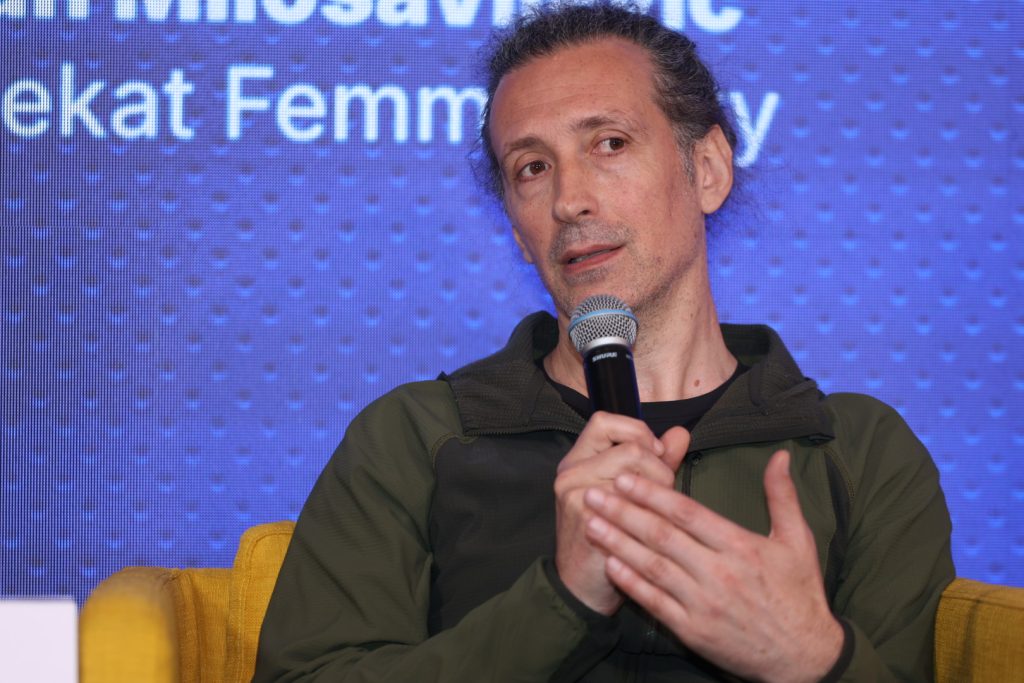
Bojan Milosavljević of the Creative Europe Desk Culture, editor of the autumn cycle “Books in the Spotlight”, on women’s voices, European literatures we rarely read and the role of young people.
According to the results of a poll by the portal Velike priče, in which more than 120 writers and literary theorists have voted so far, only 13 of the 100 best novels were written by women, five of them by Dubravka Ugrešić. The first novel written by a woman appears only in 17th place.
Bojan Milosavljević cites this figure as proof that the marginalisation and undervaluing of women’s literature persist today, and that is also the reason why the autumn cycle of conversations “Books in the Spotlight” at the European House Belgrade focuses on contemporary European women’s literature.
The cycle is dedicated to literary works whose translations were supported through the Creative Europe programme. Milosavljević has chosen four authors, whose works will be presented through conversations with publishing house editors, with the participation of translators and students of the Philological Grammar School in Belgrade.
Which books are at the centre?
In October, the focus is on the cult novel Daljine by the Hungarian writer Magda Szabó, published by Štrik. November is dedicated to Bulgarian authors: Rene Karabash, whose novel Ostajnica was published by Heliks, and Marija Kasimova-Moase, author of the novel Balkanska rapsodija (Balkan Rhapsody), published by Akademska knjiga. In December, the conversation is about the novel Antarktik ljubavi by the Swedish writer Sara Stridsberg, published by Kontrast.
How involved are publishers from Serbia in the Creative Europe programme, especially in projects supporting the circulation of European literary works?
Every year, with the support of the Creative Europe programme and through the call Circulation of European Literary Works, publishers from Serbia translate and publish on average about 40 new titles of contemporary European literature. This trend has lasted for more than ten years, and nearly 20 publishing houses have carried out projects so far. The titles come from almost all of the 40 countries taking part in the programme, from Portuguese and Polish to Icelandic and Irish literature.
“I think one of the problems of our society is that people hold views about Europe based on insufficient information and an understanding of the complexity of European history and culture. These translations build new intercultural bridges and make it possible to get to know contemporary European societies in a specific and authentic way”, says Milosavljević.
Why is it important to talk about literature written by women, and what guided you in choosing the four authors and their works for this year’s autumn cycle?
“Women’s literature is a relatively new phenomenon on the world literary scene. Until almost the middle of the 20th century, women were denied the right to education, basic literacy and economic rights, which Virginia Woolf wrote about in her essay A Room of One’s Own”, Milosavljević explains.
He therefore sees his series of conversations as a reaction to, and a correction of, historical injustices and systemic violence that for centuries prevented women from expressing, through literature, their view of themselves, the world and social relations.
“When women write, there are more female characters in novels and a greater variety of their social profiles, while in the literature written by men for centuries women are mostly marginalised. Women’s literature, then, brings a new sensibility and new themes, as well as a new reading of gender roles and social relations”, says Milosavljević.
All four novels in the autumn cycle were written by women, and in each of them women are central characters. This is also in line with one of the general priorities of the Creative Europe programme, the European Union’s cultural policy: inclusion and gender equality.
The choice of authors from Hungary, Bulgaria and Sweden, he adds, is a response to the dominance of Anglo-Saxon, French, German and Russian culture and literature: more than 90% of translated literature, as well as compulsory school reading, comes from these languages.
“You will very rarely find, in your surroundings, a person, unless they work professionally with literature, who has read a novel from Portuguese, Romanian, Polish or some other less represented European literature”, says Milosavljević.
How important is it to open space for conversation about violence and social trauma through literature?
In November and December, “Books at the Centre” is part of the campaign “16 Days of Activism against Gender-Based Violence”. The November conversation is dedicated to the novel Ostajnica, which in an innovative way addresses the phenomenon of sworn virgins in Albania, and the December one to the novel Antarktik ljubavi, which addresses the problem of femicide in Sweden. Milosavljević believes it is important to have literature that critically reflects on existing social relations and opens a dialogue about social trauma and violence against the powerless, with the intention of contributing to a more just, freer and more solidary world.
“Literature, like culture, does not have just one face. It can sing of freedom, empathy and emancipation, but it can also serve as a means of normalising violence”, he says.
Why is it important to involve the younger generation in conversations about sensitive social topics?
The autumn cycle is carried out in cooperation with students of the Philological Grammar School, who will take part in the conversations both as interlocutors and as audience. Milosavljević believes young people should be given the chance to have their voices heard and should be treated as serious and equal interlocutors able to reflect on sensitive social topics. He thanked literature teacher Mirjana Stakić for her understanding and openness to cooperation.
“I believe the young interlocutors will breathe freshness and hope into our conversations”, says Milosavljević.