
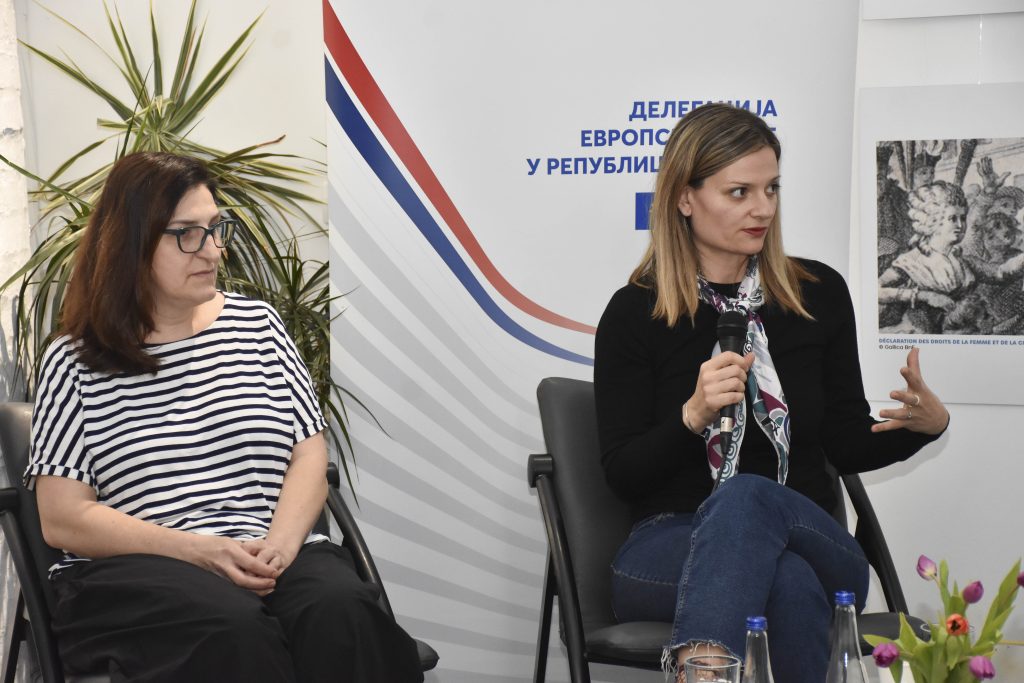
“At the French Institute in Novi Sad, in late March, the conversation about motherhood was nothing like a panel with ready-made answers. On the contrary, it was an encounter of experiences, dilemmas, and small everyday truths that are rarely spoken out loud.
Within the event ‘Open Studio Europe: Motherhood in Dialogue,’ women spoke about balancing work and family, the pressures of modern life, but also those quiet moments of intimacy that give meaning to it all.
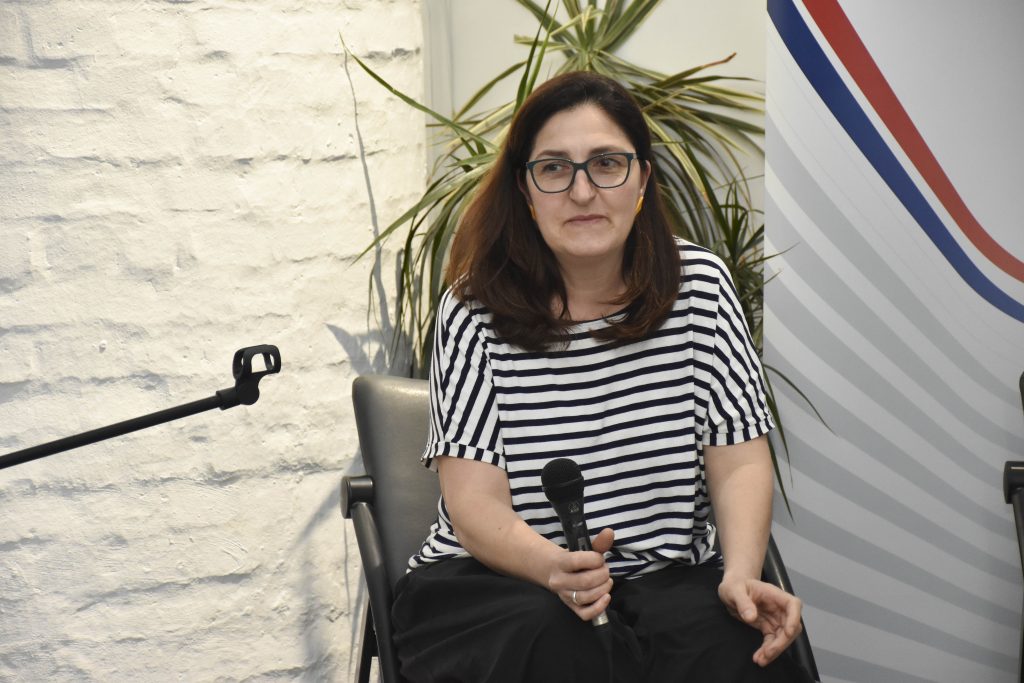
Among them was Blagovesta Vasileva, an artist originally from Bulgaria, who has lived and worked in Zrenjanin for years. Her story, woven between two cities, two languages, and multiple identities, is one of those that doesn’t easily fit into simple categories.
“For me, home is wherever my family is. I still experience my hometown in Bulgaria as home because my parents are there waiting for me, just as I do with Zrenjanin, where my child is growing up,” says Blagovesta.
In her case, the professional path and personal choices did not run in parallel; instead, they were constantly intertwined. As a freelance artist, she spent years working with various theaters and projects, often with no clear boundary between her private and professional life.
‘I was so preoccupied with work that I didn’t even notice how time was passing. I feel that I came to motherhood a bit late. My work is dynamic, without traditional working hours, so I often find myself “juggling” to get everything done. The theater in Zrenjanin has a special spirit, and that is exactly why I decided to establish myself professionally there.’
Speaking about the differences between Bulgaria and Serbia, Blagovesta doesn’t insist on borders, but rather on nuances.
‘I wouldn’t say there are major differences in the cultural context of motherhood. But in Zrenjanin, I notice something that seems to me like a nostalgically positive example—many young, dedicated parents and a strong sense of community.’
For her, community is not just about support, but also a space of responsibility—especially through art.
‘Through my work in the theater, I feel a need to contribute to that togetherness, to create content that is meaningful and communicates with children and families. I often say that every play is like my child; I cannot pick one out and call it the best,’ she says with a smile. ‘Motherhood is an inseparable part of my professional life and has enriched it immensely. It has given me a new perspective on the world—through the eyes of a child.’
In that sense, play and creativity are not just a part of childhood, but a way of understanding the world. That is why, she adds, theater for children is not merely art.
“Through play, a child learns to express emotions in a natural way. Children’s puppet theater is a space where a child doesn’t just observe, but actively experiences the world—visually, sonically, and emotionally. It is a safe place where a child builds their character and develops freedom of thought. And perhaps most importantly, it is a space for a shared experience between parent and child.”
The conversation at the French Institute opened up questions about boundaries, expectations, and the ways in which women today attempt to reconcile their various roles. Between the feeling of exhaustion and the need for intimacy, motherhood—as the participants demonstrated—cannot be reduced to a single definition.
The ‘Motherhood in Dialogue’ event was realized as part of the Open Studio Europe program, in partnership with the French Institute in Novi Sad. Through this program, the European House Novi Sad strives to create a space for dialogue on contemporary social issues, connecting local experiences with a broader European context and values such as solidarity, equality, and mutual understanding.