
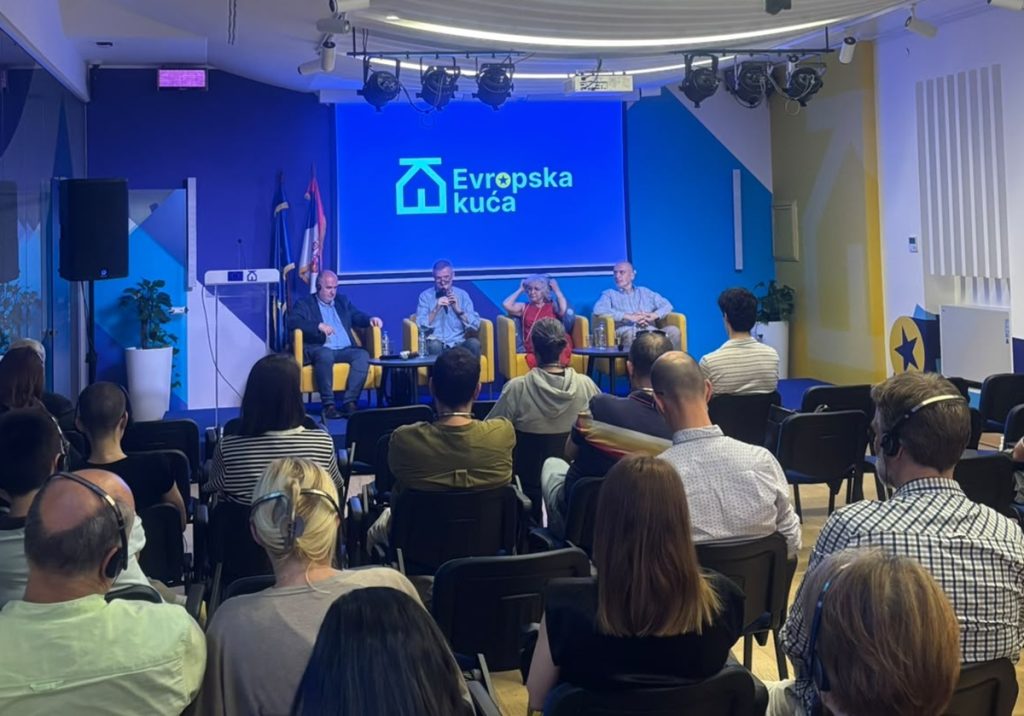
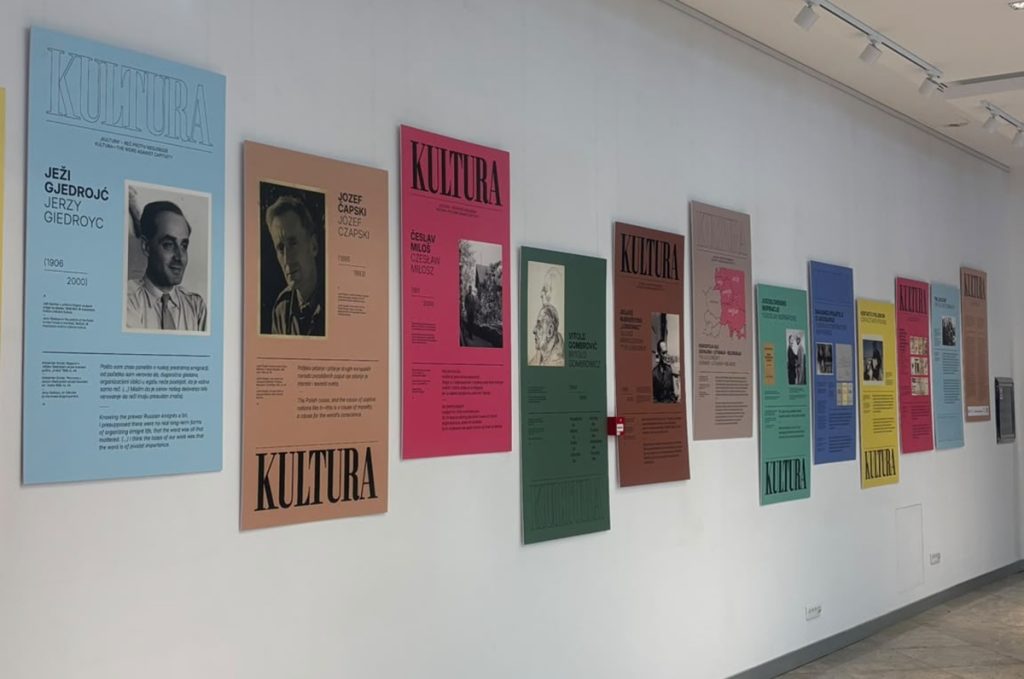
The documentary exhibition “A Word Against Unfreedom”, dedicated to the historic work of the Polish Literary Institute in Paris and its iconic journal Kultura, opened on 16 June at the European House in Belgrade. The opening was followed by a panel discussion on the legacy of the Paris-based Kultura and the vision of Jerzy Giedroyc.
During the discussion, experts highlighted the institution’s pivotal role in defending freedom of thought during the Cold War, with a particular focus on its founder and legendary editor, Jerzy Giedroyc. The panel featured distinguished guests: Professor Sławomir Nowinowski, historian and author of the exhibition; Anna Bernhardt, President of the Kultura Association; and Dr Vladimir Todić, historian. The discussion was moderated by journalist and philosopher Ivan Milenković.
Organized in cooperation with the Polish Institute in Belgrade, the exhibition takes visitors through the history of the émigré intellectual centre in the Paris suburb of Maisons-Laffitte. For decades, the Literary Institute served as a beacon of free expression and a forum for dialogue among intellectuals from across Eastern Europe who opposed totalitarian regimes.
Jerzy Giedroyc: The Editor Who Shaped Geopolitics with Words
The central theme of the discussion was the figure of Jerzy Giedroyc himself—a man remembered in the history of European culture simply as the Editor. Giedroyc was far more than a publisher; he was a visionary and a political realist, free from national myths and cheap sentimentalism. Around Kultura, he gathered some of the most influential names in Polish and European émigré circles, including Witold Gombrowicz and Nobel Prize laureate Czesław Miłosz, transforming the written word into one of the most powerful weapons against ideological darkness.
The panelists introduced the Serbian audience to Giedroyc’s pioneering “ULB Doctrine” (his concept for relations with Ukraine, Lithuania, and Belarus), through which he advocated, decades ahead of his time, abandoning territorial claims and building bridges with neighbouring nations based on mutual recognition and sovereignty.
For our region, Giedroyc’s life and work carry an important lesson. The message conveyed in Belgrade was that his example demonstrates how cultural and intellectual centres, even in complete exile and without state funding, can outlast political regimes and help lay the foundations for a modern, democratic, and united Europe. Giedroyc’s legacy shows that free media and independent thought remain essential pillars of society, particularly in times of crisis.
The exhibition “A Word Against Unfreedom” will remain open to visitors until 27 June, and admission is free of charge. More information on opening hours and accompanying programmes is available on the European House website and the social media channels of the Polish Institute in Belgrade.