

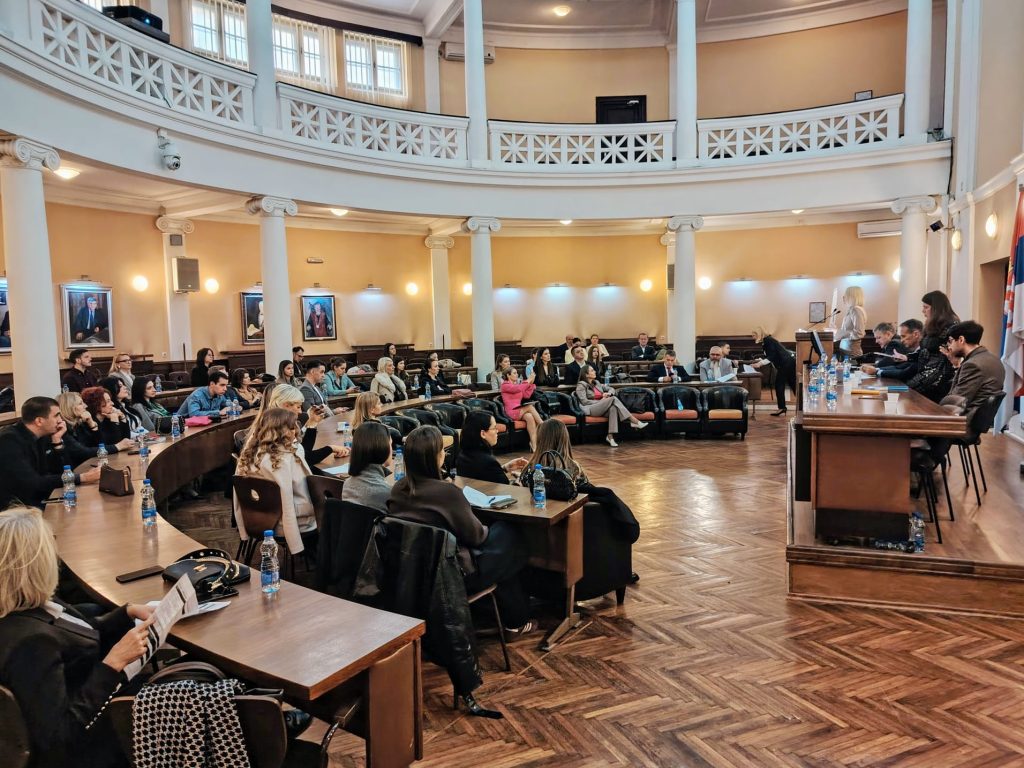
Can an algorithm help a judge without taking the judge’s place? On 16 October, in the Great Hall of the University in Niš, professors of the Faculty of Law and the Faculty of Sciences and Mathematics, public prosecutors, lawyers and data protection experts discussed exactly that. The round table on the ethical principles of using artificial intelligence in the judiciary and in business was held as part of Erasmus Days 2026.
Three Jean Monnet projects of the University of Niš were also presented: the SAIL2EU Centre of Excellence on the legal and financial aspects of sustainability in the age of artificial intelligence, the WISER module on the European Union’s water policy and the DIGIRIGHTS module on digital transformation and human rights. Jean Monnet activities are part of the Erasmus+ programme, through which the European Union supports teaching and research on European integration.
The event was opened by Prof. Dr Dragan Đorđević, Vice-Rector for Science of the University of Niš. In the first panel, the speakers were Prof. Dr Predrag Cvetković, Dean of the Faculty of Law, on the relationship between rules and code, Prof. Dr Branimir Todorović of the Faculty of Sciences and Mathematics on how language models are taught ethical reasoning, and Prof. Dr Maja Nastić on the use of artificial intelligence in the judiciary.
What can the judiciary hand over to artificial intelligence?
In her talk, Nastić reminded the audience that technology in the judiciary is nothing new. It began with computers replacing paper, and today there are electronic case files, searches of large databases of regulations and case law, and remote hearings. Artificial intelligence is the next step: it can help in drafting decisions, and legal chatbots can make it easier for citizens to get information about their own rights. She warned that digital justice must not create new inequalities, because progress depends on citizens’ digital literacy and the availability of technology, and systems must rest on reliable data and relevant case law.
According to her, the use of artificial intelligence in the judiciary must comply with the European Convention on Human Rights, data protection regulations and the principles of the rule of law. The Council of Europe has set five principles for the use of artificial intelligence in the judiciary: respect for fundamental rights, a ban on discrimination, data quality and security, transparency and fairness, and user control over the system. As a member of the Council of Europe, Serbia is obliged to respect them. The final word must always belong to the judge, and the system’s results must be understandable and verifiable, which is hard when it is not known how the algorithm reached its conclusion. This is known as the black box problem.
“Ethical principles should not be an obstacle to development. They are a condition for using artificial intelligence in a way that is acceptable in a democratic society based on the rule of law”, Nastić said.
“The challenge is not whether artificial intelligence will become part of the judiciary, because that is inevitable. What matters is that its use leads to a fairer, more accessible and more efficient judiciary, while fundamental rights remain protected”, she concluded.
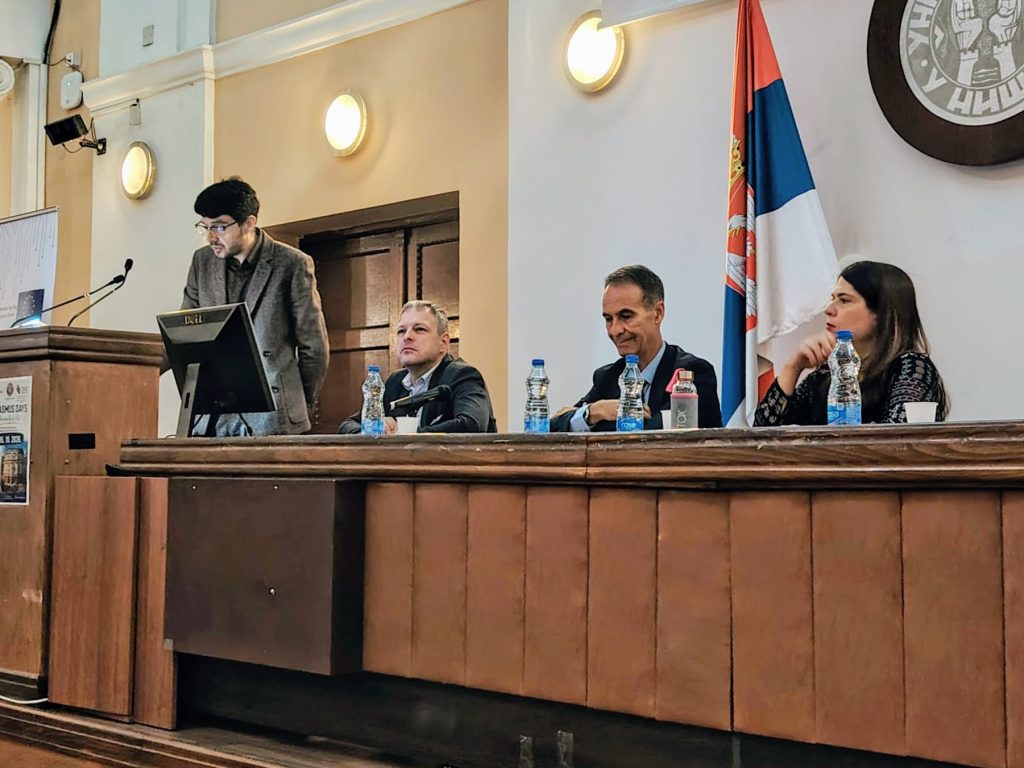
The second panel dealt with practice: financial technologies, artificial intelligence as a tool for assessing the risk of financial crime with a comparison of Italy and France, ethical and legal challenges in risk assessment of convicted persons, and how the responsibility of lawyers is changing in the age of artificial intelligence. Speakers included public prosecutors from the Higher Public Prosecutor’s Office in Belgrade and the Higher Public Prosecutor’s Office in Niš and the president of the Bar Association of Niš.
The third panel was devoted to the protection of vulnerable groups and data: medical data of patients, using the example of North Macedonia, presented by the Faculty of Law of Goce Delchev University in Štip, the age limit for children on social networks in Australia, the EU and Serbia, algorithmic bias and discrimination, which a representative of the Centre for Equality and Security spoke about, and the transparency of systems.
The round table ended with a presentation of the SAIL2EU Centre of Excellence by a professor from the Faculty of Economics in Niš and of the WISER module by a professor from the Faculty of Civil Engineering and Architecture. At the end, certificates were awarded to the second generation of participants in the Jean Monnet module DIGIRIGHTS “Digital Transformation and Human Rights: EU Perspective”.