
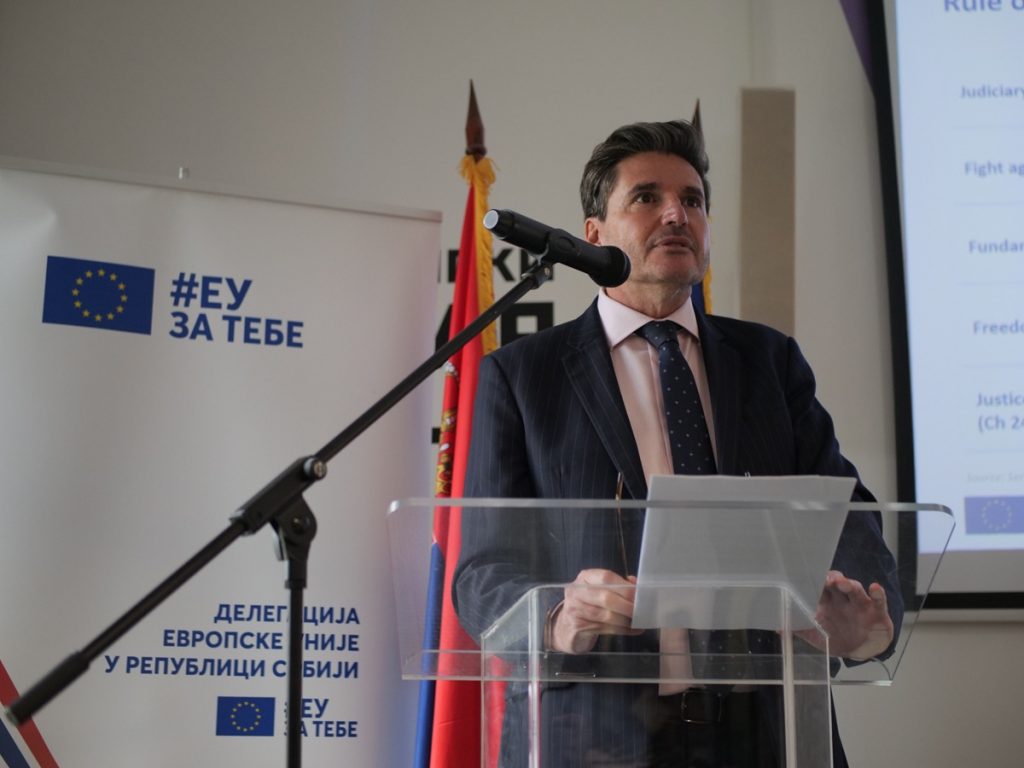
Julian Vassallo, chargé d’affaires of Delegation of the European Union to Serbia, presented the European Commission’s 2026 Report on Serbia in Novi Sad, emphasizing that citizens’ calls for transparency, accountability, and democratic reforms are at the very core of the EU accession process.
Remembering the victims of the collapse of the railway station canopy on 1 November 2024, Mr Vassallo noted that Novi Sad has been at the forefront of civic demands for institutional responsibility.
Pointing to the parliamentary elections held on 25 October, Mr Vassallo stressed that Serbian citizens clearly expressed their desire for a government that fights corruption, an independent judiciary, free media, democratic institutions that serve the public, and protected human rights.
“This is where the aspirations of Serbian citizens and the expectations of the European Union meet”.
The report covers the period from 1 September 2025 to 1 September 2026 and assesses where Serbia stands in the accession process. It notes that Serbia remains among the candidates with the highest alignment with EU law, is well prepared for the single market, and reiterates that Serbia has fulfilled the technical benchmarks for opening Cluster 3.
However, Mr Vassallo highlighted that during this reporting period, there was no progress in accession negotiations, alongside backsliding in key fundamental areas.
Izveštaj beleži izostanak napretka u pravosuđu i javnim nabavkama, i detaljno navodi nazadovanje u javnoj upravi, slobodi medija i slobodi izražavanja, kao i u obrazovanju i oblasti kulture. G. Vasalo je skrenuo
The report records no progress in the judiciary and public procurement, and details backsliding in public administration, media freedom and freedom of expression, as well as education and culture. Mr Vassallo drew attention to pressures on academic freedom, disciplinary actions against teaching staff, and concerns surrounding university autonomy, which particularly impacted the University of Novi Sad.
The assessment also highlights growing societal polarization, persistent risks of state capture, and ongoing attacks, smear campaigns, and pressure against civil society organizations and journalists. Serbia’s alignment with the EU’s Common Foreign and Security Policy remains low for a candidate country. Furthermore, Mr Vassallo underlined the necessity of moral clarity and confronting the past, noting that the glorification of convicted war criminals stands in clear contradiction to European values.
Looking forward, Mr Vassallo stressed that technical alignment cannot compensate for democratic backsliding and that progress on the fundamentals must come first.
“Accession must be owned by the whole of society, not by the government alone,” Mr Vassallo concluded. “It must be driven by facts and open debate. The European Union wants a strong and democratic Serbia as part of our Union, and we stand ready to support the future government in implementing the necessary reforms. Let us turn a new political beginning into a new beginning for Serbia’s European future.”
During the day, Mr Vassallo presented the Report in Novi Sad to local and provincial representatives, civil society organizations, students, and members of the academic community.