

Only six of the 34 steps of the Reform Agenda were completed by the final deadline, the end of 2025. The weakest area is the fundamentals, that is, the rule of law.
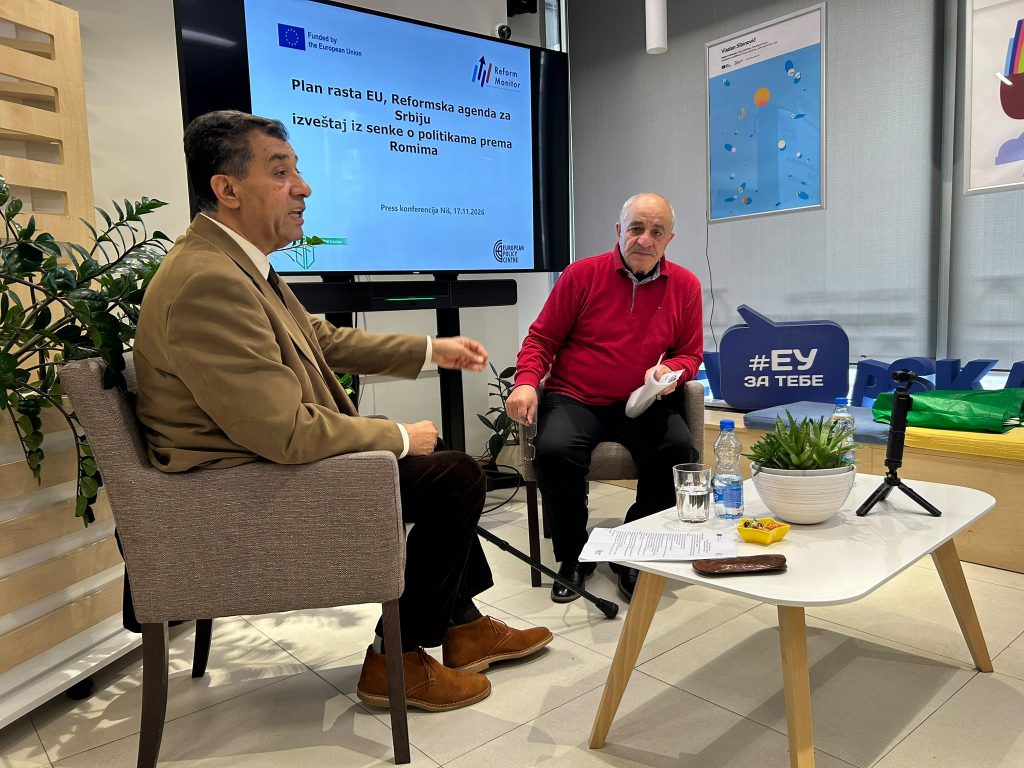
These data were presented in Niš on 17 November by Osman Balić, director of the Centre, on behalf of YUROM Centre and six partner organisations, at the first public reading of the preliminary findings from the draft Shadow Report on Policies towards Roma, viewed through the lens of the Growth Plan for the Western Balkans and the Reform Agenda for Serbia.
A shadow report runs in parallel to the official reports on the implementation of these policies. Its strength is figures.
“The report we are preparing contains no descriptive terms. It contains figures, and figures are harsh,” says Osman Balić.
The Growth Plan for the Western Balkans is a European Union initiative launched in November 2023. The region is set to receive six billion euros by 2027, of which two billion in grants and four billion in favourable loans. Serbia is allocated around 1.58 billion euros.
The condition is the Reform Agenda, a national document adopted in October 2024, with 98 concrete steps and deadlines, on the principle of more reforms, more money. Payments depend on results achieved. Serbia has submitted a request for the payment of a tranche, and is waiting for the official reports to be completed.
Life of the Roma community in figures
According to the 2022 census, 131,936 Roma live in Serbia, around two per cent of the population, while organisations estimate that the real number is considerably higher. Unemployment is over 30 per cent. Around 27,000 unemployed Roma are registered, almost half of them women, and the share of the long-term unemployed is around 67 per cent.
Among young people aged 18 to 24, only 27 per cent are working, in education or in training. Among young Roma women, nine out of ten are outside all three categories. Around one per cent of Roma have higher education, compared with 23 per cent in the general population.
There is progress in education. Every year, around 2,500 Roma children start first grade. The Ministry of Education funds 316 pedagogical assistants from its budget, spending around 355 million dinars a year on them, as well as 60 teachers of the Romani language. In the 2025/26 school year, 1,119 scholarships were awarded to secondary school students, totalling around 90.6 million dinars, with accommodation and meals provided.
The problem, Balić says, lies right at the start. A Roma child enters first grade bilingual, since Serbian is often their second language, and the official report they received from the Ministry of Education a few days ago contains no data on preschool attendance among children aged three to five.
“Why have we relied for twenty years on the saying that there are no places in kindergartens for Roma children?” Balić asks.
Serbia, Balić says, is lagging behind other countries in the region, although it once led the way, and has been particularly stagnant in recent years. Roma organisations, he adds, are not political parties and care only about results, so they also call for Roma to be present in ministries, in the positions of state secretaries.
If the pace does not pick up, Balić warns, the funds may be lost, and with them an opportunity for the Roma community.