
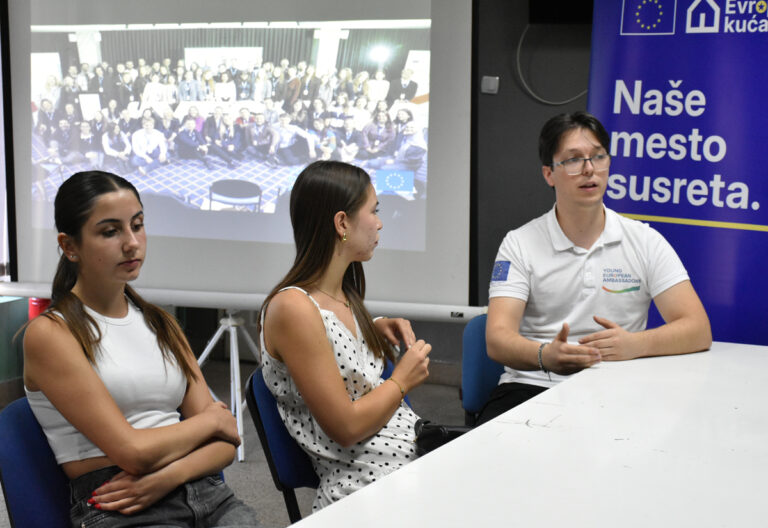
To mark International Youth Day, observed by the United Nations since 1999, the Prokuplje Culture Center hosted an event where young people from the town heard from their peers, members of the Young European Ambassadors network and participants in Erasmus+ projects. Instead of a lecture on how EU youth programmes work, the speakers were young people who had already been through them.
Why do young people hesitate before applying to EU projects?
A call for a European project usually arrives as good news. Yet before the final decision, young people often face doubts: is their English good enough, will they fit in easily with the group, will they dare to speak their mind in front of people they have never met. That step, between the call and the decision, is often the biggest obstacle between young people and the opportunities offered by European Union programmes.
What is the Young European Ambassadors network?
The Young European Ambassadors network was presented by Uroš Šestović, one of its members.
“I had the chance to share with young people from Prokuplje what the Young European Ambassadors network is, what we do, and how we contribute to our local communities, our countries, and the whole region,” says Šestović.
The network was launched in 2020 under the European Union’s regional communication programme for the Western Balkans, WeBalkans, and is open to young people aged 18 to 29 from Albania, Bosnia and Herzegovina, Kosovo, Montenegro, North Macedonia, and Serbia. It now has around 240 members, and the generation selected in the latest call included 22 young leaders from Serbia.
How does Erasmus+ help young people from Serbia?
The opportunities for cooperation with young people from the region were described by Anđelija Janković.
“When I got the call for an Erasmus+ project, I hesitated over whether to go, because of my English and because I wasn’t sure I’d find people I clicked with, or feel comfortable enough to share my opinions,” she says.
She went, on a project focused on public speaking.
“It helped me a lot. Since I came back, I still use that experience today,” says Janković. “I learned to relax in front of people I don’t know.”
Anđela Aranđelović went through a similar journey. As a member of the “Đuka Dinić” Scout unit in Niš, an organisation that designs its own Erasmus+ projects and partners with organisations from other countries, she has taken part in six projects. She singles out one in particular, on how nature affects stress, as especially meaningful.
“It meant a lot to me because I saw how others deal with problems,” says Aranđelović. “We shared experiences, how I dealt with my own problems, which was useful for them, and for me too.”
Erasmus+ is the European Union’s programme for education, training, youth, and sport. In Serbia it is implemented by the Tempus Foundation, which has been responsible for the programme’s youth component since 2016.
What appears in figures and calls for proposals as “mobility” looks more concrete in these young women’s experiences: the ability to speak in front of strangers, a skill that stays with them after they come home, and the realisation that peers in another country are solving the very same problems, just in a different order.
“I’d recommend everyone try this new experience,” says Janković. “You won’t regret it.”