
A plastic net of apples weighing half a kilogram and a shipping box that is more than half empty. After 2030, neither will be allowed on the European Union market, and the rule also applies to producers from Serbia who export to that market. Nenad Budimović, doctor of veterinary medicine and secretary of the Association for Livestock and Livestock Products Processing at the Serbian Chamber of Commerce, spoke about this and other important food safety issues at a lecture at Europe House Niš.
This refers to the EU regulation on packaging and packaging waste, which has applied since August this year. The ban on single-use plastic packaging for pre-packed fresh fruit and vegetables weighing less than one and a half kilograms takes effect at the beginning of 2030, together with the rule that empty space in grouped, transport and e-commerce packaging must not exceed half of its volume. The reasons, he says, are transport and environmental impact, because a smaller volume means more products in the same truck.
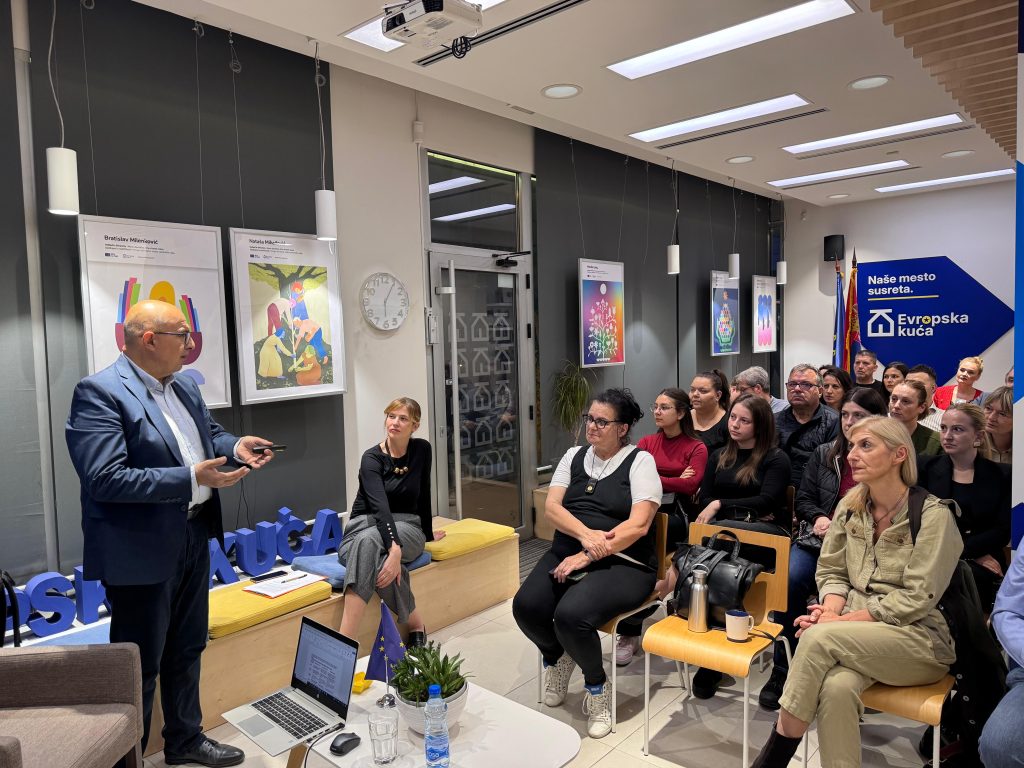
The lecture was held as part of the “Future of Food” cycle, which Europe House Niš carries out with the Science Club of the Centre for Professional Development Niš, before a large number of participants.
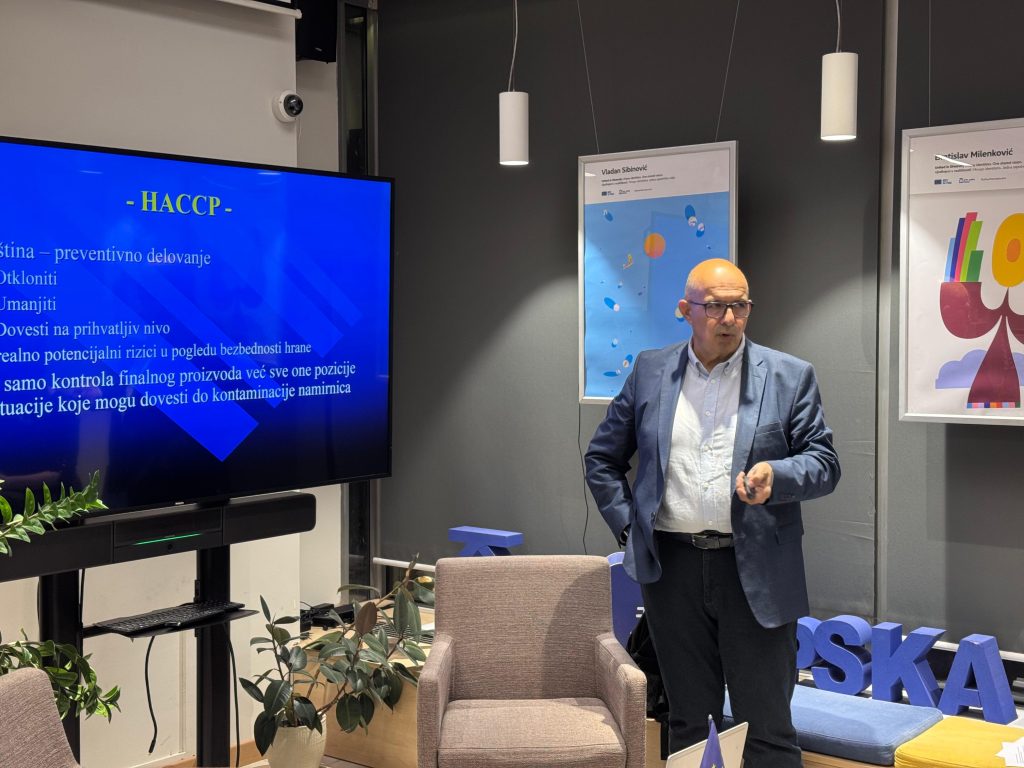
Packaging is, however, only part of the story. From the field and the farm to the buyer there are six steps: production of raw materials, their transport, processing, storage, transport again, and only sixth, retail, when the buyer comes into contact with the product. Each of them is a control point with its own sub-points, and when a product is broken down into these steps, says Budimović, you can see how much can go wrong.
At the very start he separated two terms that are mixed up in everyday speech.
„Quality and health safety are two completely different directions, but they complement each other. What is of good quality does not have to be safe for health, and vice versa“, Budimović explained.
Corn, for example, can be perfectly safe but of poor quality, and vice versa. Both terms are regulated by rulebooks, domestic ones that are being aligned with European ones, and for every product there is a minimum below which one must not go. That is why the focus is on the HACCP system, a system of control of hazards and critical control points in production. In the past the final product was checked; today the process is checked during production, so it is possible to react immediately. If a record shows that the temperature was not right, the product is stopped at an early stage, not only after packaging.
Although it is often believed otherwise, the rules apply equally to large and small producers.
„Producing small quantities does not release anyone from responsibility. Whether someone made a hundred litres of yoghurt or a hundred thousand litres of yoghurt, the responsibility is the same once they reach retail“, Budimović stresses.
Speaking about additives, he stressed that industry cannot do without them, but that control must exist, especially when it comes to children. Budimović warns that a child who during the day drinks a glass of fizzy drink and eats a bag of crisps and a bag of gummy sweets may come close to the maximum daily dose of permitted additives. According to him, additives add up, so even smaller amounts from several products build on each other. An additional problem is that in the production of small quantities, people often work who have no food-industry training, and additives are not an area where improvisation passes. They are also not interchangeable: for dry-cured meat products, which are not heat-treated, different ones are used than for cooked products such as frankfurters and bologna.
Particular attention is drawn to doubts about the labels “organic”, “bio” and “eco”. Budimović stresses that they are not a matter of the producer’s choice but are legally protected both in the European Union and in Serbia, which recently regulated this area with a new law aligned with the European regulation. They may appear only on a product made according to those rules, with a certificate from an authorised control body. He reduced the logic often encountered in practice to a single sentence: „this is my bio product, it is organic because the sheep graze at fifteen hundred metres“. Words such as “natural” or “homemade” are not regulated and anyone can write them.
Budimović puts consumer education first, from children in primary schools to pensioners, with pregnant women, babies, small children and athletes as groups that require special attention. Certification should become routine, with affordable prices from certification bodies and training for small producers.