
“Feed” Has Become the Front Page: How Algorithms Are Changing Independent Journalism in the Western Balkans
A growing share of the public uses social networks as their primary source of information.
This raises a fundamental question for independent and non-profit media in the Western Balkans: who plays the role of editor today, journalists or the algorithms of big technology platforms?
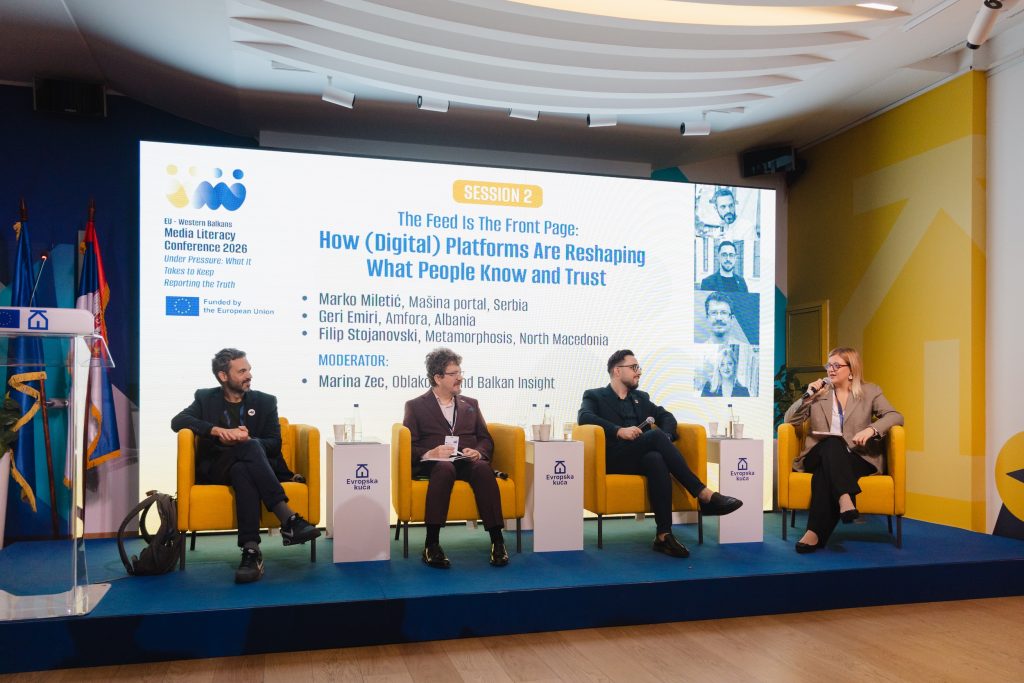
At a regional panel discussion on digital platforms and editorial integrity, held on 7 October 2026, journalists and researchers from Albania, North Macedonia and Serbia said platforms have taken over the role of the new news moderators, while newsrooms must find a balance between adapting technically to formats and preserving professional standards and the trust of their audiences.
The Algorithm as Intermediary and the Loss of Direct Audiences
Panel participants pointed out that the algorithm has effectively replaced the traditional front page of media websites, as a shrinking number of users visit news portals directly and instead consume content by searching on their mobile phones.
“Today we are faced with algorithms and a feed that change daily, weekly or monthly, and we have to keep up with that. But for non-profit and alternative media, the key is that we are not influencers or entertainment pages; we must follow the audience, but we must not change ourselves”, said Geri Emiri of the Albanian outlet Amfora.
He stressed that newsrooms remain the editors of their content, but not the editors of algorithms on large networks such as the platforms of Meta (Instagram and Facebook) or the network X (formerly Twitter), where the algorithm controls the flow of information and can create indifference towards certain media. Even though citizens today can report from the streets in real time with photos and videos, society still needs journalists who verify information and do investigative journalism.
According to Marko Miletić of the Belgrade-based outlet Mašina, technological formats have always shaped media content, like the print format fifty years ago.
“We are the editors of our content, but we try to reshape it and present it in different ways for different audiences on social networks. We are responsible for what we publish, but the problem is that we do not control the platforms themselves”, said Miletić, adding that media have always depended on outside actors, in print or television broadcasting.
Production Pressure and Audience Fragmentation
The change in audience habits has led to deep demographic fragmentation. Emiri noted that five years ago media mostly published one long investigative text on a website, whereas today it is necessary to produce short video formats for younger audiences on Instagram and TikTok, longer documentary videos for YouTube, audio chronicles for podcasts and infographics.
This approach, however, puts enormous pressure on small newsrooms with limited human resources. Journalists at small independent media increasingly have to take on the roles of social media managers, because content cannot simply be transferred from one platform to another and requires special adaptation.
According to Miletić, Mašina began a strategic adaptation of its formats six months before the civil unrest of November 2024. The shift from classic long analyses to video “explainers” brought the newsroom significant growth: more than 50,000 followers on Instagram and nearly 200,000 on Facebook.
Platform Rules: Censorship, Violence and Lack of Transparency
Panellists warned that the business logic of large platforms favours content that provokes strong emotional reactions and division, while at the same time imposing uneven and restrictive rules on reporting.
During the protests in Serbia, journalists faced the fact that TikTok does not allow the display of violent scenes, which forced the Mašina newsroom not to post such material on that network in order to avoid having its account shut down, while the same footage was published on Instagram and the platform X. At the same time, professional footage by independent media is often misused by pro-government tabloids, such as Informer, to portray protesters in a negative light.
In Albania, mass citizen protests against corruption and non-transparent tourism projects in the south of the country managed to break through the censorship of mainstream media precisely thanks to social networks and posts by citizens and influencers. However, while videos from the streets reached millions of views thanks to the algorithm, analytical and investigative texts on disinformation received no support from the algorithms. In addition, platforms rejected sponsored posts dealing with critical social topics.
The spread of manipulative narratives through coordinated ecosystems linked to foreign actors was also noted, including channels sympathetic to Russia or the Iranian regime on the network X, which spread disinformation about the protests.
Power Asymmetry: Small Balkan Media Versus Tech Giants
Communication with global technology giants is a particular challenge for newsrooms in the region. Although media in Serbia have managed to establish some contacts with representatives of Meta so they can respond to attacks on their accounts, it is extremely difficult to reach the responsible teams in large corporations.
Filip Stojanovski of the Metamorphosis Foundation in North Macedonia said that small media markets are at a disadvantage because platforms base their decisions on profit and market size.
Stojanovski said that only the legal framework of the European Union has the capacity to compel platforms to take responsibility and curb harmful practices, and that aligning candidate countries’ laws with the EU is the only way for these states to come into the focus of technology companies.
A paradox in partnership programmes for fact-checking with Meta was also pointed out. Although fact-checkers identify inaccurate content, articles that debunk disinformation have no algorithmic advantage on the networks. On the contrary, such content is subjected to coordinated reporting and discrediting campaigns, and paid promotion of fact-checking texts is often rejected because of strict corporate rules on “social issues”.
Social Polarisation and the Erosion of Public Debate
Participants assessed that social networks are not the only cause, but are a powerful tool for deepening the polarisation encouraged by authoritarian politicians.
Political actors increasingly bypass traditional debate and use social networks to deliver messages directly to their own “bubbles” of the public. As an example of the trivialisation of public dialogue in Serbia, the appearance of the leading candidate of the ruling party was cited, who posted on social networks a video of himself debating with a rock.
Stojanovski warned that the space for reasoned debate is shrinking and turning into shouting, while the model of a media conglomerate from Serbia that spreads disinformation to attract audiences is being copied across the entire Balkans.
Non-transparent media financing is an additional problem. In North Macedonia, between 6 and 11 million euros of state money is allocated during election cycles for advertising that is channelled through political parties, without any check on whether the media receiving the funds serve the public interest. In Serbia, on the other hand, the Centre for Research, Transparency and Accountability (CRTA) launched a pioneering initiative to cut off funding for disinformation outlets, appealing to European Union companies to withdraw advertising from media that promote anti-European narratives.
Building Resilience Beyond the Control of Algorithms
Speaking about practical responses to disinformation and algorithmic dependence, panellists stressed the importance of media literacy, innovative tools and diversification of channels.
In North Macedonia and the region, an early warning system called “Infrared radar” has been developed. Together with a network of partners from the Western Balkans, it maps risks and predicts potential disinformation narratives before they escalate. Fact-checking is increasingly used as an educational method in which readers are given a detailed account of the methodology and sources so they can assess the accuracy of information themselves.
At the same time, newsrooms stress the need to strengthen their own platforms (websites, YouTube channels and even print editions) through support programmes such as those of GIZ and the Media Academy, to reduce vulnerability in case their social media profiles are blocked.
In moments of crisis and social upheaval, the main defence of independent journalism remains strict adherence to professional verification. Miletić said that during the student protests in Serbia they deliberately refused to publish unconfirmed names from student lists despite public pressure, stressing that in sensitive social moments professional selection of information takes priority over the race for clicks.