
Worryingly Low Media Literacy in the Western Balkans
Traditional media barely cover media literacy at all.
The Western Balkans are going through political turmoil marked by information manipulation, while investigative media, the bright spot of the media landscape, face pressure as they try to keep their audiences on their websites and bring citizens accurate information.
The European Commission’s report, which includes an assessment of media and freedom of expression in enlargement countries, is expected soon, but editors of investigative media in the region believe the Commission’s findings will not be positive.
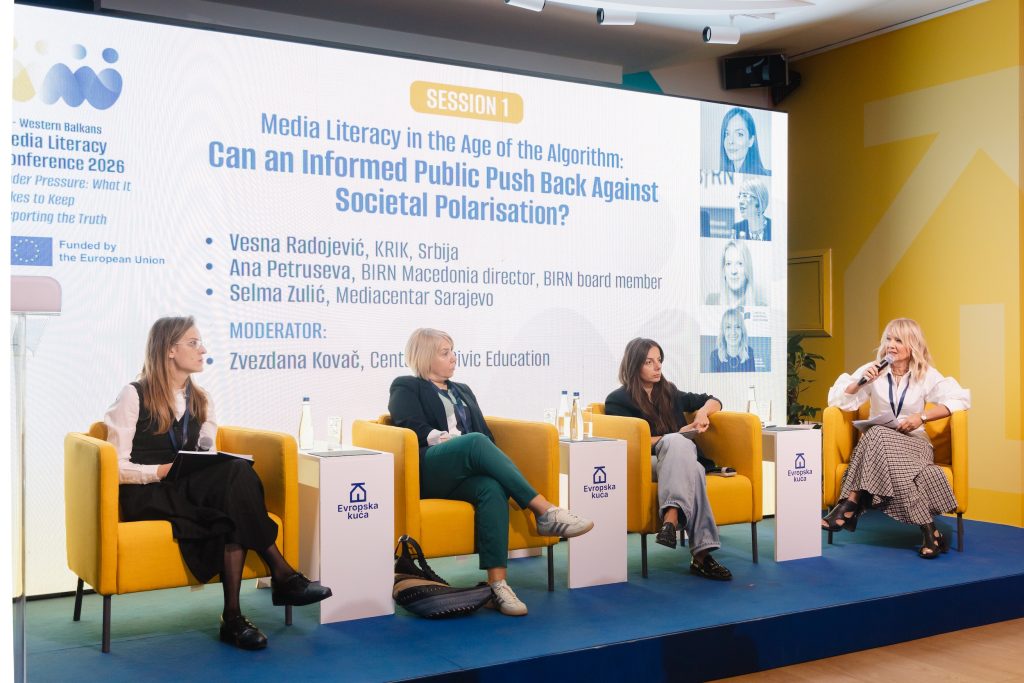
These are just some of the conclusions of the media literacy panel at the conference “Media Under Pressure: How to Keep Reporting the Truth”, organised by the Delegation of the European Union to Serbia on 7 October 2026.
Vesna Radojević, journalist at the Crime and Corruption Reporting Network (KRIK) and editor of “Raskrikavanje”, said the media literacy situation in Serbia is worrying.
“Social networks and various digital platforms are where we can hear debate and criticism of the Government, because we do not have traditional media that would allow this. We have seen this ever since the student protests began in Serbia. Students run their campaign on social networks, and they also go door to door and talk to people. But their campaign is focused primarily on social networks”, said Radojević, illustrating how new channels of public communication replace traditional media when those media close their doors to certain groups or ideas.
She said social networks are where people can see what is really happening in Serbia, adding that for investigative media, platforms are the only channel of communication.
“Every time we face a smear campaign, we receive a lot of donations from individual donors in Serbia. KRIK started relying on citizens’ support back in 2015. I think that after Netflix and other platforms, people got used to paying for online content. Last year, donations made up 20 percent of KRIK’s annual budget. That is quite a lot of money” said Radojević.
In her view, most traditional media in Serbia are “machines for the Serbian Progressive Party”.
“We have no problem reaching our audience. Our problem is the various kinds of pressure we face. There are campaigns against us, such as smear campaigns, financial pressure and security threats. This is not only the case with KRIK journalists, but with journalists from other media outlets too”, she said.
On information manipulation and fake news, Radojević said this area is “not very advanced in Serbia”.
“There is no alternative. If you want to do your job, you will do it despite all the pressure. We have neither the institutions nor the political will to improve things in Serbia”, said Radojević.
She added that media literacy should be part of the school curriculum, not just a subject of training sessions.
Ana Petruševa, journalist at the Balkan Investigative Reporting Network (BIRN) in North Macedonia, said the situation with media and audience engagement in her country is “pretty disastrous”, because media “chase content that triggers emotions or brings lots of clicks”, leaving editorial independence and the public interest at the bottom of the list.
“However, BIRN does investigative journalism. Precisely because this kind of content cannot be found anywhere except on the BIRN website, the audience comes to us”, said Petruševa.
“Our audience has been growing for years, and that is a reward for months of work on our stories”, she said.
On media literacy, she noted that older citizens are less educated in this area and watch “only what is served to them between two Turkish soap operas”.
“The entire older population gets information mostly from TV and is very susceptible to propaganda. On the other hand, you have young people who are digital and on TikTok. These two worlds do not talk to each other. Older people in North Macedonia rely much more on TV than young people do”, said Petruševa.
She added that media are under great pressure to make their content more visible to the algorithms that decide which articles are picked up and shown on social networks and other platforms.
“Macedonian media do not use artificial intelligence creatively. Content is simply copied, and journalists do not even bother to slightly edit the text ChatGPT gives them. Literally the same content keeps circulating in the media again and again”, she added.
Selma Žulić from Mediacentar Sarajevo agreed that the media are in a difficult position when it comes to media education and media literacy.
“We are far behind in this area and we need to speed up and engage all generations. On the other hand, important factors working against us are editorial policies that do not focus on media literacy, and there is less and less funding for a systematic programme in this field. Institutionalising this process in Bosnia and Herzegovina has not been successful at all, because it has turned into a political issue”, said Žulić.
She stressed that the situation in other Western Balkan countries is no different, as they have also failed to include media literacy in their education programmes.
She recalled that elections were held in Bosnia and Herzegovina a few days ago and that the algorithms that manage content in the media and on social networks fuelled polarisation during the campaigns.
“The campaign is over, but it is still a turbulent time for editors and journalists. We are reporting on the results around the clock, and the algorithm has done its part in this environment: there have been many conflicts between citizens. Fortunately, they were not armed. But this is happening in a society with a low level of media literacy and little awareness of how algorithms work and how they shape our opinions”, concluded Žulić.